International Forum “SOCGOV 2026: Digital Analytics for Smart Governance” Held in Khankendi
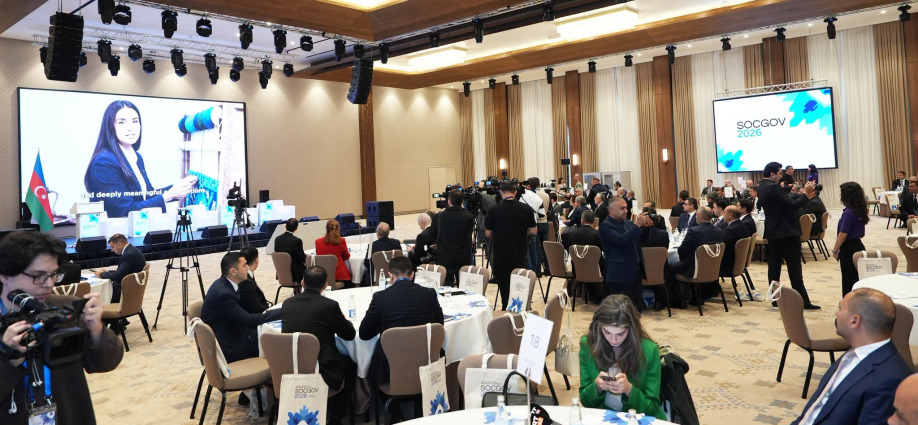
The international forum “SOCGOV 2026: Digital Analytics for Smart Governance” was held in Khankendi, organized by the DOST Agency under the Ministry of Labor and Social Protection of the Population.
Bringing together government officials from various countries and local and international experts, the forum aimed to assess the prospects for applying artificial intelligence and digital analytics in social services, identify innovative solutions for establishing a more accessible, responsive, and transparent model of interaction between the state and citizens, and exchange leading practices in implementing smart governance models.
At the event, participants were welcomed by SAİDA (Social Artificial Intelligence DOST Agency), an artificial intelligence solution developed by the DOST Agency, which served as the moderator.
At the opening of the forum, Minister of Labor and Social Protection of the Population Anar Aliyev noted that the event was taking place during the days marking the sixth anniversary of the Patriotic War, in which the Azerbaijani Army achieved a historic Victory under the leadership of President and Victorious Supreme Commander-in-Chief Ilham Aliyev. He highlighted the social support measures implemented for the families of martyrs and war veterans.
The Minister emphasized the symbolic significance of holding the “SOCGOV 2026” International Forum in Khankendi, noting that it provided an opportunity to showcase the new life being built in the liberated territories and the smart city concept.
Anar Aliyev highlighted the substantial increases in social payments resulting from five social reform packages implemented in Azerbaijan since 2018, with additional annual funding amounting to AZN 8 billion. He also noted that, in accordance with the President’s instructions, preparations were underway for the next, sixth social reform package aimed at increasing social payments.
The achievements in digitizing the Ministry’s services were highlighted. Information was presented on the Ministry’s efforts to introduce artificial intelligence across four key priority areas, including disability assessment, improving employment services, automating administrative processes, and developing digital interaction with citizens.
The advantages of the DOST concept, initiated by First Vice-President Mehriban Aliyeva, were highlighted, and it was noted that more than 90% of services provided at DOST centers had been digitized. It was also emphasized that Moldova, Uzbekistan, Serbia, and other countries had expressed interest in learning about the DOST concept. The success of the Ministry’s social reforms in recent years has been recognized through more than 300 international awards and certificates, including the United Nations Public Service Award.
Anar Aliyev expressed confidence that the forum would serve as an important platform for assessing the prospects for applying artificial intelligence and digital analytics in social services, identifying innovative solutions to establish a more accessible, responsive, and transparent model of interaction between the state and citizens, and exchanging leading international practices.
Türkiye’s Minister of Labor and Social Security, Vedat Işıkhan, expressed confidence that the “SOCGOV 2026” International Forum would make a significant contribution to joint efforts to shape the future of social policy. He noted that Türkiye was continuing the digital transformation of public services, with the “e-Devlet Kapısı” portal serving as its main digital platform and providing citizens with fast, secure, and centralized access to a wide range of public services. According to him, by the end of 2025, the number of users of the portal had exceeded 68 million. More than 9,000 services are currently available through the platform. Türkiye’s Ministry of Labor and Social Security views digitalization as a key tool for improving service quality and strengthening institutional capacity.
Ulvi Mehdiyev, Chairman of the State Agency for Public Service and Social Innovations under the President of the Republic of Azerbaijan, emphasized that the “ASAN xidmət” model was a successful example of an innovative approach to public service delivery. He noted that the model contributed to simplifying administrative procedures, optimizing service delivery processes, and strengthening trust between the state and citizens. He also commended the DOST Agency’s efforts to introduce digital solutions in social services and strengthen its citizen-centered approach.
In a video address, Marcelo Abi-Ramia Caetano, Secretary General of the International Social Security Association (ISSA), emphasized that artificial intelligence, data-driven solutions, and digital public services offer significant opportunities to make social security more accessible, responsive, inclusive, and people-centered. He expressed confidence that the discussions at “SOCGOV 2026” would contribute to new ideas and practical solutions for the future of social security. Christian Fillet, President of the European Social Network, also highlighted in his video address the benefits that digital analytics, artificial intelligence, and data-driven decision-making bring to social services, as well as the significance of the forum.
A panel session titled “Innovation Demands Speed, While the State Requires Rules: How Can the Balance Be Achieved?” was held as part of the forum. The session was moderated by Farid Mammadov, Chairman of the Board of the DOST Agency. The speakers included Mihai Gabriel Ciobanu, State Secretary at Moldova’s Ministry of Labor and Social Protection; Alexandros Varveris Georgios, Director of Greece’s Electronic National Social Security Fund (e-EFKA); Laman Ibrahimova, Head of the ASAN Artificial Intelligence Center; and Nijat Hajikhanov, Data Governance Specialist at the Luxembourg National Data Service.
The event continued with TEDx-style debates featuring Khayala Fatullayeva, Head of the Digital Economy Department at the Center for Analysis and Coordination of the Fourth Industrial Revolution, and Mehmet Ali Varol, Head of the Data Science Group at Türkiye’s Doğuş Teknoloji, as well as discussions in thematic working groups.
The forum adopted a Declaration. In the document, participants expressed their support for developing the SOCGOV initiative into an institutional and sustainable platform for international dialogue, the exchange of experience, and partnership aimed at shaping the future of social governance. The Declaration emphasized the need to expand the use of reliable data, modern analytical tools, and evidence-based decision-making mechanisms in the development and implementation of social policy.
Parallel sessions, special presentations by partner organizations, and a joint event organized by “ASAN xidmət” and Karabakh University were also held as part of the “SOCGOV 2026: Digital Analytics for Smart Governance” International Forum.
The delegations from Türkiye and Uzbekistan attending the forum visited Victory Park in Khankendi. Minister Anar Aliyev briefed the guests on Victory Park and the Victory Arch complex. The delegations also visited Karabakh University.


